
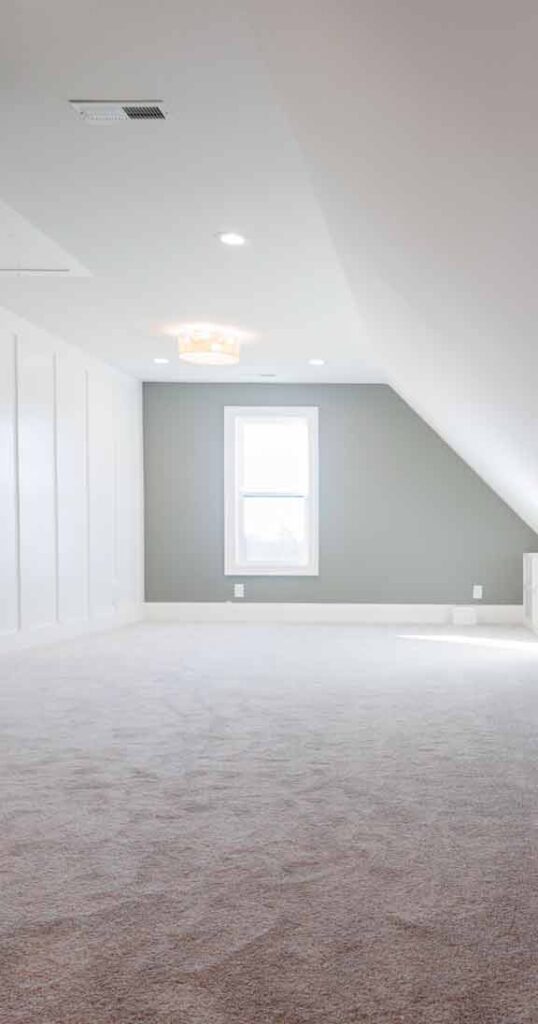
A single reel. 2.7 million views. And a whole lot of questions. Here’s everything you wanted to know about attic conversions from SKC.
When SKC shared a reel about a recent attic renovation on Instagram, nobody expected it to hit 2.7 million views. But the response made one thing clear: homeowners across Lebanon, TN and Middle Tennessee are hungry for real information about what’s actually possible with an attic conversion – not the sanitized version, but the honest answers about permits, HVAC, costs, and what it really takes to pull it off right.
So the SKC team went through the comments and pulled out the best questions. This post answers every single one of them.
If you’re thinking about an attic conversion in Lebanon TN, this is the guide you’ve been looking for.
What Is an Attic Conversion and Can Any Attic Be Converted?
An attic conversion transforms an unfinished attic space into a usable, livable area – whether that’s a bedroom, office, bonus room, bunk room, or anything in between.
The honest answer to “can any attic be converted?” is: many can, but not all. The feasibility depends on several structural and mechanical factors.
What Makes an Attic Convertible?
- Ceiling height: Most building codes require a minimum of 7 feet of headroom over at least 50% of the finished floor area. Attics with steep enough roof pitches often meet this threshold.
- Floor structure: The existing floor joists must be able to support a live load (people, furniture). Most attic floors are built for storage, not habitation, so reframing is often required.
- Access: There has to be a way to get up there – usually a staircase, not a pull-down ladder.
In the viral project, SKC tackled the floor structure challenge head-on. The team reframed the floor without ripping out the ceiling below – a more complex approach, but the right one for the scope of the job. To support the framing between the first and second floors during the reframe, temporary walls were built downstairs. This is the kind of structural attention to detail that separates a safe, permitted conversion from one that creates problems years down the road.
Do You Need a Permit for an Attic Conversion?
This was one of the most-asked questions, and the answer is: it depends – but usually yes.
Here’s the breakdown:
When a Permit Is Required
- Adding or modifying HVAC: Anytime you’re extending ductwork or installing new equipment to serve the converted space, a permit is typically required.
- Electrical changes: New outlets, lighting circuits, or panel upgrades all require permits in most jurisdictions, including Wilson County.
- Structural changes: Reinforcing floors, adding walls, or modifying roof support structures require permits because they affect the safety and integrity of the home.
- Changing the official use: When an attic goes from storage to habitable living space, most municipalities require a permit to document that the space meets code.
When a Permit May Not Be Required
- Cosmetic updates only: Flooring, paint, and built-ins in a space that’s already finished and designed for use may not require a permit.
- Pre-framed attics in new construction: Some newer homes include attic spaces pre-framed for future finishing, which simplifies the permit process significantly.
The SKC team navigates permitting for renovation projects in Lebanon, Wilson County, and throughout Middle Tennessee as part of the process. Homeowners don’t need to figure out permit requirements on their own.
What About HVAC – Does the Attic Need Its Own System?
Yes, HVAC is one of the most important – and most commonly underestimated – parts of an attic conversion.
In the viral project, SKC reconfigured the existing HVAC system to accommodate the new living spaces. That’s not always possible. In most conversions, the existing system doesn’t have the capacity or ductwork layout to properly heat and cool an added finished space.
The Honest Answer on AC Unit Upgrades
When asked directly, SKC’s answer was refreshingly straightforward: “We didn’t have to on this renovation, but most of the time it’s necessary.”
Attics are notoriously difficult spaces to condition – they absorb more heat in summer and lose it faster in winter than any other part of the home. Skimping on HVAC in an attic conversion leads to uncomfortable spaces, high energy bills, and potential moisture problems down the road.
Options for conditioning an attic conversion include:
– Extending existing ductwork (when the current system has capacity)
– Adding a mini-split system (efficient and doesn’t require ductwork)
– Upgrading the central system to handle the additional load
How Big Can an Attic Conversion Be?
The size is determined by the footprint and pitch of your existing roof – not a contractor’s imagination. In the viral SKC project:
- The office space: 30 x 40 feet
- The bunk bed room: 14 x 16 feet
A 30×40 office in an attic is genuinely impressive – and it underscores what’s possible when a home’s original structure supports it. Not every attic will yield that kind of square footage, but even smaller conversions can dramatically increase livable space without the footprint of an addition.
What Colors Were Used in the SKC Attic Conversion?
This question flooded the comments – proof that people pay attention to the details.
- Office wall color: Storm Cloud Grey by Benjamin Moore
- Bunk beds: Newburyport Blue by Benjamin Moore
Both are part of Benjamin Moore’s Classic Colors collection. Storm Cloud Grey reads as a sophisticated, grounded neutral that works well in spaces with natural light from dormers or skylights. Newburyport Blue is a classic coastal-inspired shade that gives the bunk room a calm, timeless feel – perfect for a kids’ sleeping space.
How Long Does an Attic Conversion Take in Lebanon TN?
Timeline depends heavily on the scope of structural work, HVAC changes, and finish level. As a general guide:
- Simple conversion (mostly cosmetic, structure already sound): 4-8 weeks
- Moderate conversion (some structural work, HVAC reconfiguration): 8-16 weeks
- Complex conversion (floor reframing, full HVAC upgrade, custom finishes): 3-6 months
The viral SKC project fell into the complex category given the floor reframing work. Front-loading the structural and mechanical decisions – before any finish work begins – is how SKC keeps timelines predictable.
What Does an Attic Conversion Cost?
This is the question everyone wants answered, and the honest answer is: it varies significantly based on scope.
Rough cost ranges for attic conversions in Middle Tennessee:
- Basic finishing (insulation, drywall, flooring, basic electrical): $25,000-$50,000
- Mid-level conversion (structural work, HVAC reconfiguration, quality finishes): $50,000-$100,000
- High-end/complex (major structural changes, premium finishes, full HVAC upgrade): $100,000+
The best way to get an accurate number is to have a contractor walk the space and assess what the structure actually needs. Ballpark estimates without a site visit are often misleading in either direction.
Is an Attic Conversion Worth It?
For most homeowners, yes – especially in the Lebanon and greater Nashville market where adding livable square footage translates directly to home value.
An attic conversion delivers several distinct advantages over a traditional home addition:
- No new footprint: You’re building up, not out – no additional land required
- Cost per square foot: Often lower than ground-level additions because the shell is already there
- Minimal disruption to exterior: The home’s curb appeal and landscaping are largely unaffected
- Versatility: Offices, bedrooms, playrooms, bonus rooms, art studios – attic spaces can serve almost any function
Ready to Talk About an Attic Conversion Lebanon TN?
SKC handles renovations across Lebanon, Mt. Juliet, Wilson County, and the greater Nashville area. If you’re wondering whether your attic has potential, the first step is a simple conversation.
Contact us to schedule a walkthrough of your current space, or follow SKC on Facebook or Instagram to be the first to know about upcoming Meet the Builder events
SKC specializes in renovations, custom homes, room additions, and outdoor living spaces in Lebanon, TN, Mt. Juliet, Wilson County, and throughout Middle Tennessee.